



























11 Minute Read
Which Acoustic Foam is Best?
Foam is cheap, everywhere, and promises a lot. Here's what it genuinely does, where it falls short, and when something else is the better answer — from a company that doesn't sell it.

Mark Irwin
6th Aug 2025
Categories
Advice
Published 6 August 2025 · Last updated 30 July 2026
If you’re treating a home studio, a small office or a spare room, acoustic foam is usually the first thing you find. It’s cheap, it’s everywhere, and every listing promises to transform your space.
Here’s the honest version. We don’t sell acoustic foam and we don’t install it, so we’ve no reason to talk it up or talk it down. What follows is what it genuinely does, where it falls short, and when it’s the right call anyway.
TL;DR
- Acoustic foam absorbs mid and high frequencies reasonably well. It works.
- It blocks nothing. Foam will not stop noise coming through a wall, floor or window, at any thickness or price.
- It’s weak at low frequencies unless it’s very thick — most tiles you’ll buy do little below about 1 kHz.
- Fire performance is the real problem, and it’s why foam is rarely appropriate in commercial buildings.
- For a bedroom studio on a budget, foam is a perfectly sensible choice. For anything permanent, public or commercial, it isn’t.
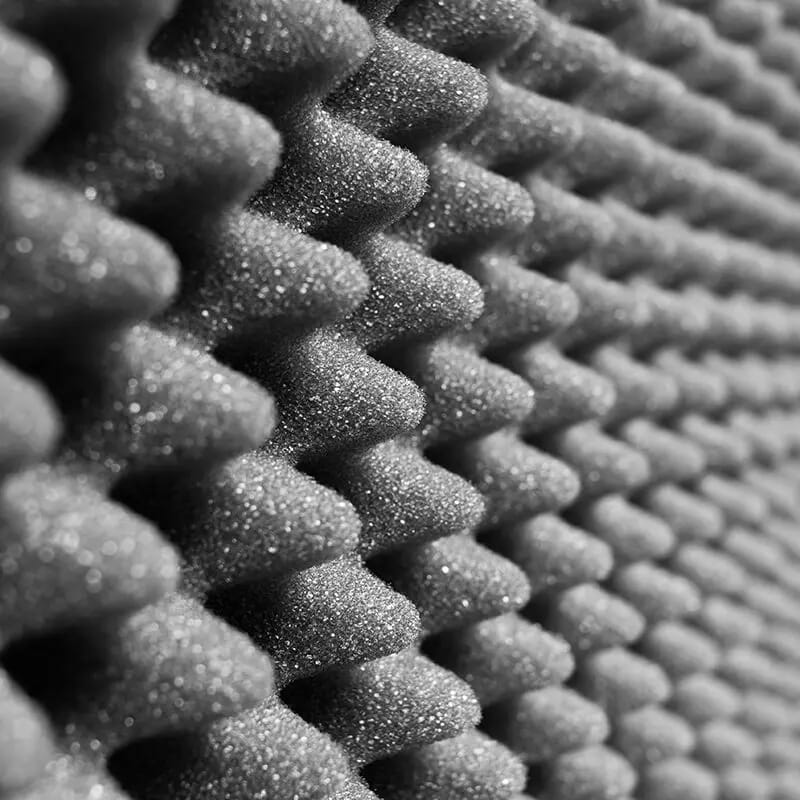
What does acoustic foam actually do?
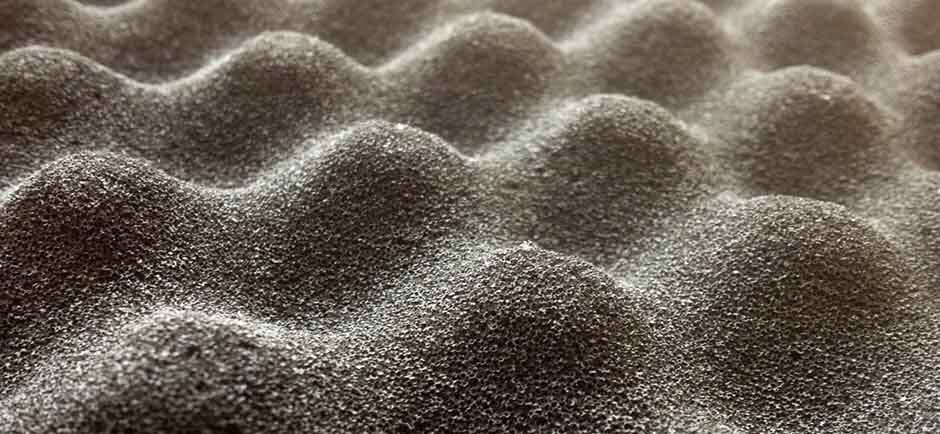
Acoustic foam is an open-cell porous absorber. Its structure is full of interconnected air pockets, and when a sound wave passes into it, the air inside those pockets is forced to move against the walls of the material. That friction converts a small amount of the sound energy into heat. Less energy reflects back into the room.
The audible result is less reverberation. Speech gets clearer, recordings pick up less room, and a space stops feeling harsh and fatiguing. That’s a real effect and a useful one — foam is not a con.
What doesn’t it do?
Foam will not stop sound getting into or out of a room. Not thin foam, not thick foam, not expensive foam, not foam covering every surface.
Blocking sound between spaces requires mass and decoupling — dense layers built into the structure, isolated so vibration can’t pass straight through. Foam is light and porous, which is precisely what makes it a good absorber and precisely what makes it useless as a barrier. Sticking it on a party wall will change how your own room sounds and will not change what your neighbour hears.
This is the single most common misunderstanding in acoustics, and it’s worth being clear on before spending anything. We’ve written a fuller explanation in soundproofing vs acoustic treatment.
Three limitations worth knowing about
1. It struggles with low frequencies
Porous absorbers only work well down to roughly the frequency where their thickness equals a quarter of the sound’s wavelength. That’s a useful rule of thumb, and it’s unforgiving: a 50 mm foam tile is doing very little below about 1 kHz, and effectively nothing in the bass.
Which is why a room covered in thin foam often sounds worse rather than better. The top end gets absorbed, the low end doesn’t, and you’re left with something dull and boomy at the same time. If bass build-up is your problem, you need depth — thick corner traps or a designed absorber, not more tiles.
2. Fire performance
This is the one that matters most, and it’s the reason foam almost never appears in commercial specifications.
Standard open-cell polyurethane foam is combustible. It ignites readily, spreads flame quickly and produces dense, toxic smoke. Melamine foams perform considerably better and are the ones you’ll find in professional settings, but the cheap tiles sold in bulk online are usually polyurethane.
Reaction to fire in the UK is classified under BS EN 13501-1, which gives products a Euroclass rating from A1 down to F. Any product being installed in a workplace, school, public building or rented property should have a documented rating. A great many foam products sold online have none at all — and no rating means no evidence, not a good rating. Our in depth fire rating guide goes through what the Euroclass system actually measures.
If you’re treating a room in your own home, that’s your risk to weigh. If you’re specifying for a building anyone else uses, it isn’t a judgement call.
3. It doesn’t last
Polyurethane foam degrades. It yellows under UV, oxidises, and eventually becomes friable — crumbling at the edges and shedding dust. Five to ten years is a realistic life in a bright room, less if it’s handled or cleaned. PET felt and mineral wool cores don’t do this; they’re stable, and their performance is unchanged decades later.
Open-cell or closed-cell?
Short answer: open-cell, always, if absorption is what you’re after.
Open-cell foam has interconnected pores that air can move through, which is the entire mechanism by which it absorbs. Closed-cell foam has sealed pockets, so air can’t circulate — it’s denser, more durable and more moisture-resistant, but it’s a poor sound absorber. Closed-cell foam has genuine uses in vibration damping and gasketing. Room treatment isn’t one of them.
If a listing is vague about which one it’s selling, that tells you something about the seller.
The middle ground: PET felt
Between foam and mineral wool sits PET felt, and it’s where a lot of the market has moved.
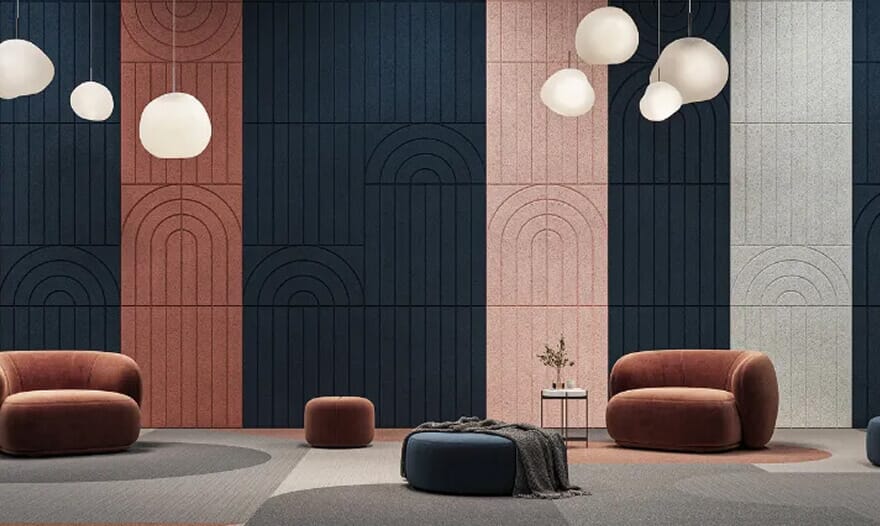
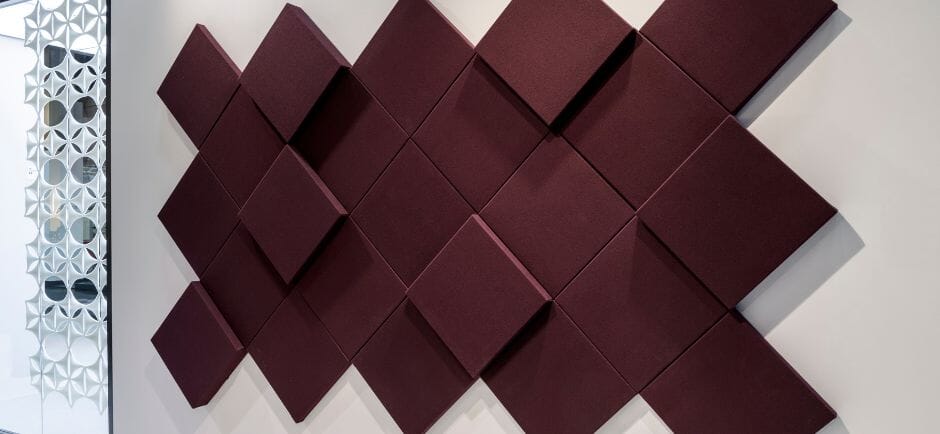
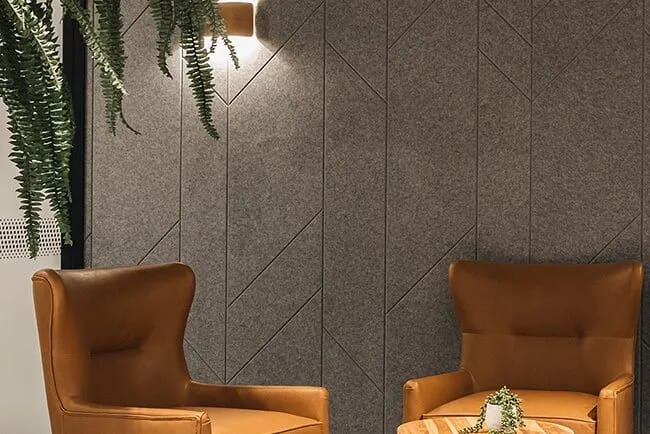
PET is a polyester felt, most commonly made from recycled drinks bottles. It’s rigid enough to stand as a panel without a frame, it can be cut, folded, layered and formed into three-dimensional shapes, and it comes in colour ranges that run to dozens of options. It absorbs comparably to foam at mid and high frequencies, and unlike foam it comes with published test data and a certified fire rating as standard.
It’s also durable in a way foam isn’t — it doesn’t shed, yellow or crumble, it can be cleaned, and it stands up to being touched, which matters in a school corridor or an open-plan office.
The recycled content is worth a mention too. If your project has sustainability requirements to satisfy, PET usually satisfies them more easily than anything else on this list.
Where it’s weaker than mineral wool is the bass. A PET panel mounted flat to a wall is doing mid and high frequency work; you get lower down by increasing thickness or mounting it with an air gap behind, which is standard practice and costs nothing extra.
Foam versus the alternatives: the honest comparison
| Acoustic foam | PET felt | Mineral / glass wool | |
|---|---|---|---|
| Absorbs | Mid and high frequencies | Mid and high; lower with depth or an air gap | Broad range, including low frequencies at depth |
| Fire performance | Poor to moderate; often undocumented | Certified Euroclass ratings as standard | Typically the highest ratings available |
| Lifespan | Degrades, yellows, crumbles | Stable, hard-wearing, cleanable | Inert; unchanged over decades |
| Test data | Frequently none published | Lab-tested as standard | Lab-tested as standard |
| Appearance | Looks like acoustic foam | Wide colour ranges, cuttable, printable, 3D forms | Fabric-wrapped, printed or colour-matched |
| Made from | Petrochemical foam | Recycled PET, usually post-consumer bottles | Mineral or glass fibre |
| Cost | Low | Middle | Higher |
That test data row is worth dwelling on. Reputable absorbers are tested in independent laboratories to BS EN ISO 354 and rated to BS EN ISO 11654, which gives you an absorption coefficient at each frequency band and a single-figure αw rating. You can compare two products and know which performs better.
Most foam is sold with no test data whatsoever — just a claimed percentage and a photograph. There’s no way to verify the claim, and no way to design a room around a product whose performance nobody has measured.
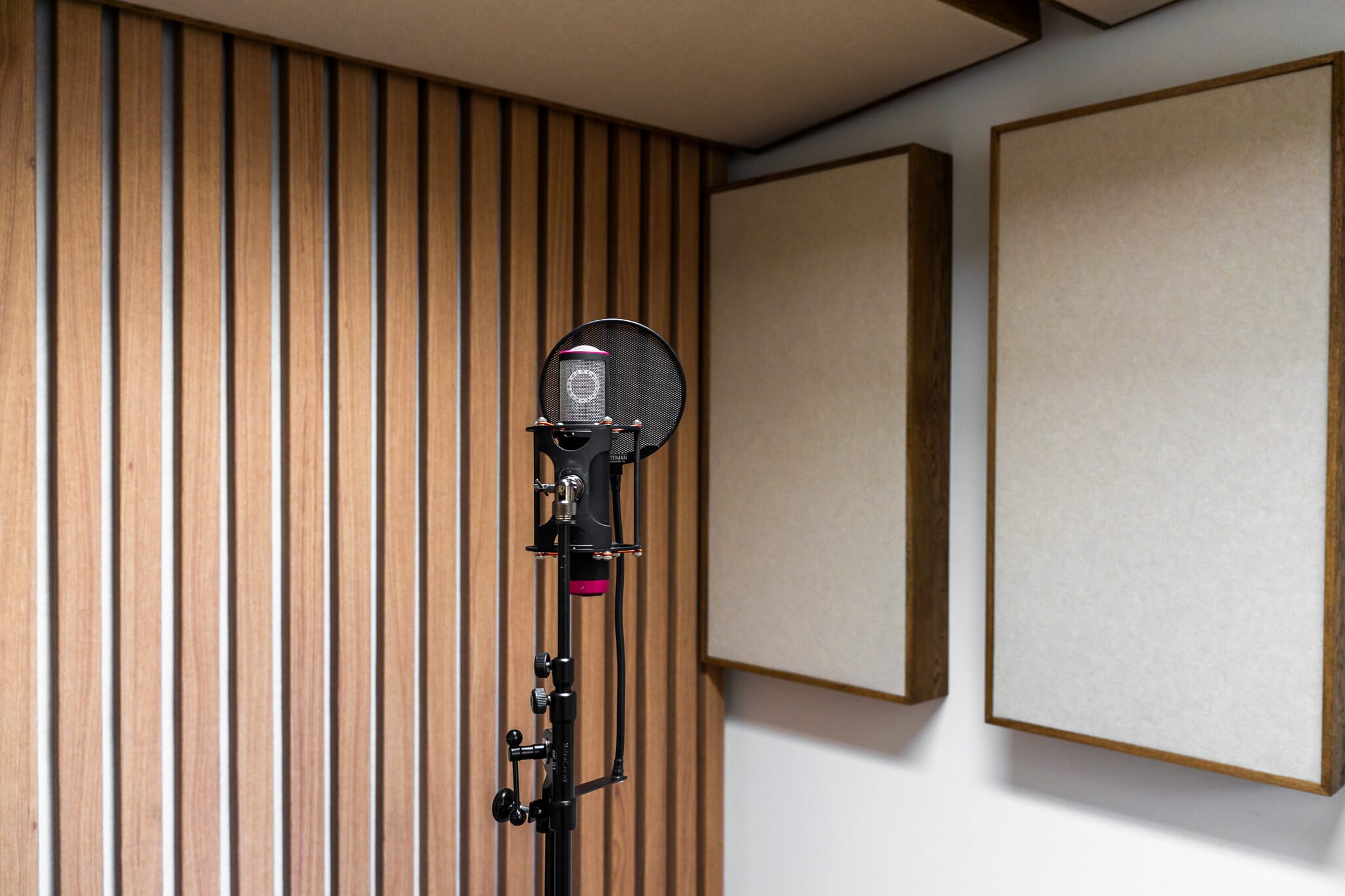
So which acoustic foam is best?
If you’re buying foam, the ranking is straightforward:
- Melamine foam over polyurethane, every time. Better fire performance and better absorption, at higher cost.
- Thicker over thinner. 100 mm does far more than 50 mm, and 50 mm does far more than 25 mm. Thickness matters more than surface profile.
- Flat over sculpted. Wedges and pyramids are largely cosmetic. The profile adds a little surface area; the depth of material is what’s absorbing.
- Published test data over marketing claims. If a supplier can’t show you an absorption coefficient, they haven’t had it tested.
- A documented fire rating. Non-negotiable anywhere but your own home.
When foam is the right choice
Genuinely, in these cases:
- A bedroom or spare-room studio where budget is the binding constraint
- A vocal booth or small recording space where you want the room out of the recording
- Temporary setups, rented rooms, anything you’ll take down again
- Experimenting to find out whether treatment helps before committing to something permanent
In those situations foam is a sensible, proportionate answer, and anyone telling you to spend ten times more is selling something.
When it isn’t
- Offices, schools, restaurants, healthcare, or anywhere the public goes — the fire question decides it
- Anywhere appearance matters to someone other than you
- Rooms where you already know there’s a significant acoustic problem — at that point you want it measured and designed, not guessed at
- Large volumes, where getting the quantity wrong is expensive and covering walls in foam still won’t fix a reverberation problem at that scale
- Rooms where low frequency build-up is the actual complaint
- Any project that needs to demonstrate measured performance to a client, a governor, or a building control officer
Why we don’t install foam
Not because it doesn’t work. Because almost everything we install goes into workplaces, schools, sports halls and public buildings, where a product with no fire certification and no test data isn’t something we could stand behind.
What we specify instead are PET felt, mineral and glass wool cores, timber systems and stretched fabric. We carry a wide range of PET brands specifically because it covers most of what people want: certified fire performance, published absorption data, recycled content, and enough colour and format options to suit an interior rather than fight it.
All of it comes with lab-tested absorption coefficients, which is what lets us design to a target reverberation time and then measure whether we hit it.
If you’re treating your own spare room, none of that applies and foam may well be all you need. If you’re treating a space other people have to use — including your own home, if you want it done properly — it’s the whole question.
Frequently asked questions
Does acoustic foam really work?
Yes, within limits. It reduces reverberation at mid and high frequencies, which makes speech clearer and recordings cleaner. It does not block sound between rooms, and it does little in the bass unless it’s very thick.
Will acoustic foam stop noise from my neighbours?
No. Nothing surface-mounted will. Stopping noise passing through a wall requires added mass and structural decoupling — building work, not panels or foam.
Is PET felt better than acoustic foam?
For most purposes, yes. Absorption at mid and high frequencies is broadly comparable, but PET comes with published test data and a certified fire rating, doesn’t degrade, can be cleaned, and is available in far more colours and formats. Foam’s advantage is price.
How much foam do I need?
It depends on the room’s volume, its existing surfaces and what you’re using it for. Coverage rules of thumb are unreliable. Treating first reflection points and corners gives you most of the benefit for the least material; covering every surface is usually wasted money and often makes a room sound dead rather than good.
Is acoustic foam a fire risk?
Standard polyurethane foam is combustible and produces toxic smoke. Melamine foam performs considerably better. Any product going into a workplace, school or rented property should have a documented Euroclass rating under BS EN 13501-1 — and many foam products sold online have no rating at all.
Is foam or are panels better for a home studio?
Foam is a reasonable starting point for a small room on a budget. Panels give broader absorption, particularly at low frequencies, along with test data and a longer life. Many home studios sensibly use foam at the reflection points and something deeper in the corners for bass.
Can I paint acoustic foam?
No. Paint seals the surface pores and stops air moving through the material, which is the mechanism that makes it absorb. Painted foam is decoration.
Article Author
Mark Irwin
Head of Marketing
6th Aug 2025